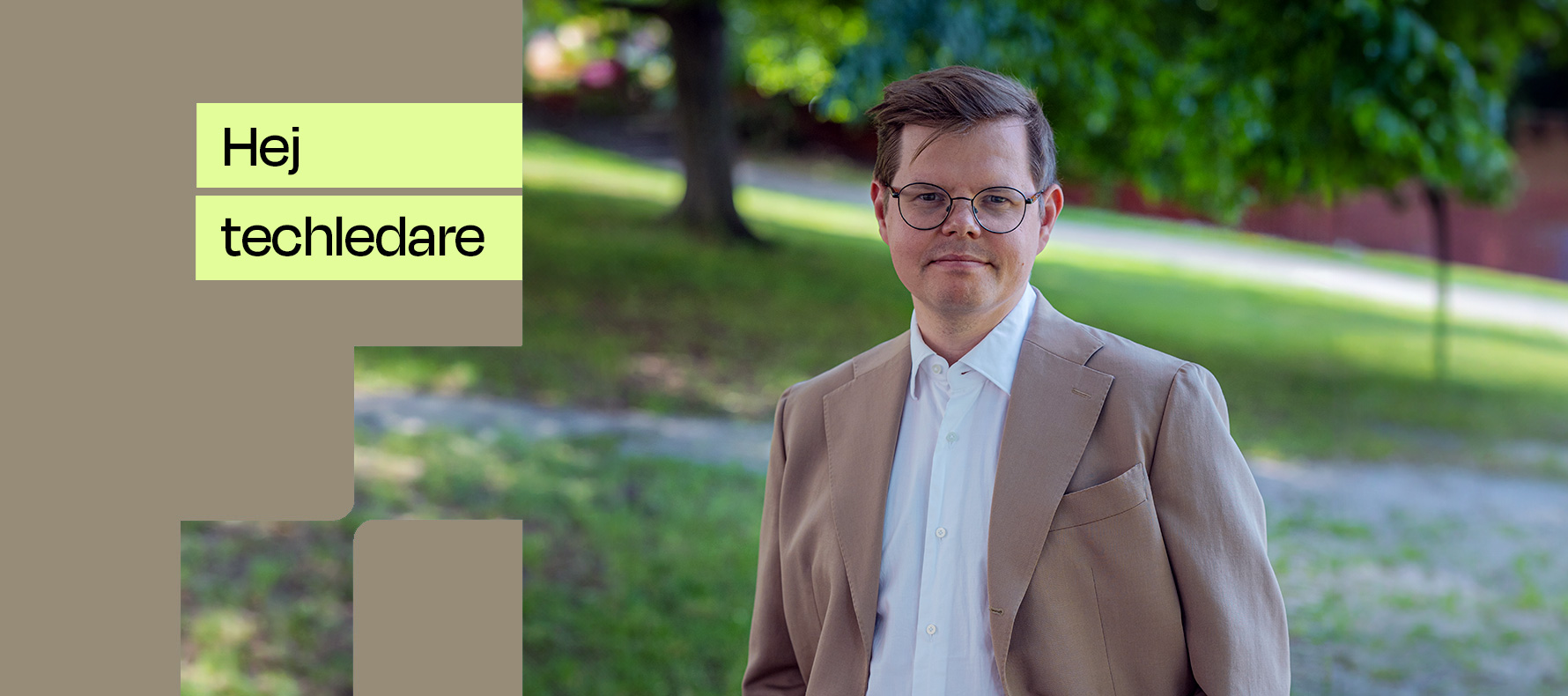
Hello, tech leaders: Gustav Karreskog Rehbinder, Vera Policy
TechSverigeis delighted to welcome Vera Policy as a member. The company’s CEO, Gustav Karreskog Rehbinder, talks about a company that recently garnered significant attention in connection with the parliamentary election.
“Vera Policy is building a knowledge engine for politics: a structured database of Swedish and European politics that not only finds text, but also understands, compares, and analyzes it. The database contains millions of documents, ranging from a century’s worth of government reports to yesterday’s meeting of the Stockholm Region,” says Gustav Karreskog Rehbinder, adding:
– This allows everyone who follows and influences politics to interact with the entire flow of debates, Replies to public consultations, investigations, and decisions on a platform they can trust. Behind every response is the full background information and sources that can be reviewed directly.
Vera Policy helps organizations operating in or near the political arena and the public sector keep up with the enormous flow of political data: debates, Replies to public consultations, reports, decisions, and proposals. Based on this data, they can produce their own background materials, statistical analyses, comparisons, and much more.
– Essentially, it’s about making politics easier to understand and enabling better decision-making.
How does AI affect your business and the market in which you operate, and what opportunities do you see going forward?
– For us, AI isn’t a bonus feature—it’s the very foundation of what we’re building. Without the technological advancements of recent years, it’s simply not possible to handle this volume of political data at the required pace. The field we’re focusing on is dominated by manual labor and basic keyword monitoring. The new technology allows us to move from simple monitoring to sophisticated environmental analysis, statistical analyses, and forecasts, all built on a comprehensive database. Another aspect worth highlighting is that quality and source criticism are crucial in this particular industry. Political decisions cannot be based on inaccuracies, so we have always placed great emphasis on reliability.
"A product designed to understand political processes must be built by people who know those processes from the inside."
Your recently published election forecast, produced in collaboration with SVT, turned out to be very accurate. What made you so successful—and what role did AI play in that effort?
– “The forecasting model itself is good old-fashioned math,” I usually say. AI support and other technical tools, on the other hand, have been worth their weight in gold for everything other than the core model itself. We’ve been able to generate a completely different range of scenarios, tests, and evaluations than we could have otherwise. AI has also been a huge help with visualizations and other diagnostic tools.
What does good tech leadership mean to you, and how has your leadership style evolved alongside the company?
– For me, good leadership is about combining technical expertise with a deep understanding of the sector we serve. And I have truly fantastic colleagues who are well-versed in both cutting-edge technology and political processes. Creating an environment where everyone’s strengths can shine is, of course, a challenge—but so far, it’s been a very rewarding one. As development costs decline, domain expertise becomes the decisive strength. A product designed to understand political processes must be built by people who know them from the inside. We have several people on the team with extensive experience in politics and political advocacy, not least our senior advisor, Fredrik Reinfeldt.
You operate at the intersection of technology and politics. What do policymakers need to understand better about rapid technological development?
– Now that enormous amounts of public information can actually be read, structured, and used, the bar has been raised significantly for what making information accessible should mean. Unfortunately, Sweden is lagging behind in this regard. We need more people to realize that while the principle of public access certainly gives us a fantastic starting point, there’s a huge difference between theoretical and practical access to data and documents. I also think many people underestimate the pace of change. AI won’t take all our jobs within five years, but developments are moving faster than most people realize. We’re facing a structural transformation that will hopefully be positive, but it’s not an issue that can be confined to an AI minister or a minister of economic affairs. It affects the whole of society, from healthcare and education to the judicial system and the entire business sector. Politicians who understand this early on have a lot to gain.
What does it take for Sweden to remain a strong tech hub and create favorable conditions for tech companies to grow?
– Regulations that enable rather than hinder, not least proportionate AI regulation and continued good access to data. Much of this is now decided at the EU level, so Sweden needs to be a clear advocate for regulations that foster innovation rather than stifle it. And a public sector that is a demanding but tech-friendly customer, with procurement processes that actually allow smaller companies to participate. Nor should we be afraid that technology will lead to structural transformation. All major technological shifts do this, and the Swedish model is fundamentally well-equipped to handle it. The ability to combine transformation with security is a strength that many countries lack. Sweden has strong assets: good digital infrastructure, high levels of trust in society, high IT competence, good data, and institutions capable of handling structural transformation. We can be the country that demonstrates that AI can truly strengthen democracy. If we succeed in that, Sweden will succeed.

Vera Policyis a Swedish AI and policy tech company that is developing a platform for political analysis and public affairs. The service collects public information—such as government bills, agency materials, and EU documents—and uses AI to search, analyze, and summarize the material.
The company behind Vera Policy,Kvantab analys AB, was foundedin 2023 in Stockholm. The company has recently expanded beyond Sweden, including into the EU market and Finland.