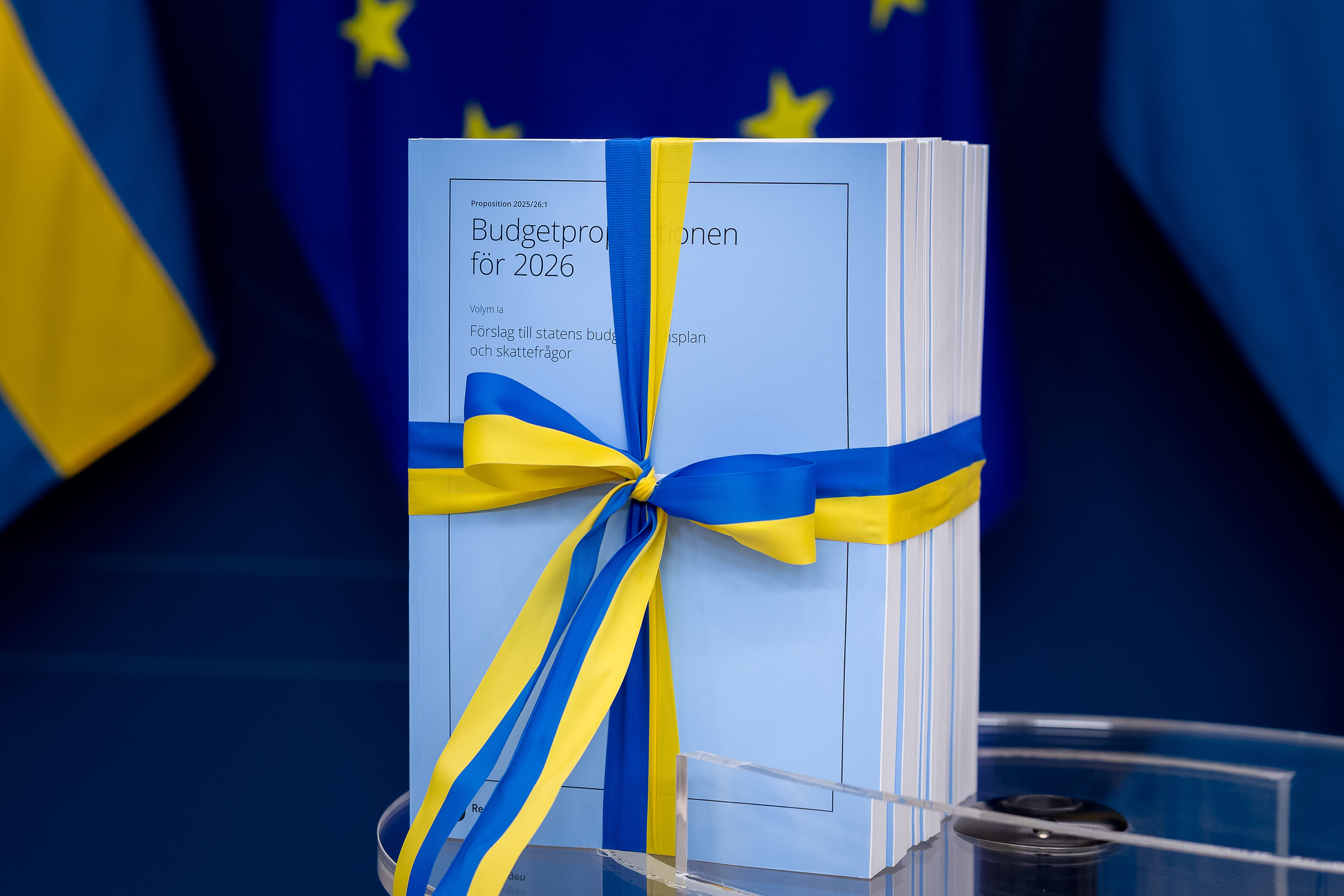
Recovery underway but long-term investments will determine the future - TechSverige's analysis of the fall budget
The government's fall budget receives a cautiously positive reception from TechSverige. The budget focuses mainly on supporting households, which is important to get Sweden out of the recession. At the same time, sustainable and larger investments are needed for a stronger business sector and increased speed in digitization to meet global challenges and drive growth. In our analysis of the budget, we highlight both strengths and weaknesses that affect the tech industry and Swedish competitiveness.
The budget bill will be presented a year before the next election, which increases expectations. The government announces ample scope for reform of SEK 80 billion in 2026, with both temporary and permanent initiatives.
It is an autumn budget that shows that we are still in a prolonged recession with subdued international developments and a weak labor market, but where the recovery is now expected to gain momentum. The Minister of Finance emphasizes that the recession needs to be broken and the budget will act as an injection. More people should feel confident about the future.
In conclusion, while the recession is protracted, the Swedish economy is expected to recover and the tech sector is showing increased investment and new business creation - providing a brighter outlook for the future.
TechSverige has gone through a number of the areas found in the budget bill
A single digital authority for a stronger tech nation
It is positive that the government in the budget takes a further step towards a single digitization authority by stating that Overall, a merger of the authorities (PTS and Digg) is considered to be an important measure for Sweden to continue to develop as a leading digitization nation. The timetable is for the new authority to be in place on January 1, 2027, with Digg's tasks being transferred to and incorporated into PTS.
A more connected Sweden
Before the summer, the government launched a new digitization strategy with connectivity as a separate strategic area with increased ambitions and increased focus on use and citizens' benefits of the networks. It is positive that PTS funding to combat digital exclusion is being increased by SEK 25 million annually. PTS will also receive increased funding to counter criminal activity and protect democracy as a result of the EU Digital Services Regulation.
AI policy on track - but now more action is needed
It is good that the government is continuing its efforts to make more data from the public administration available. The focus here must be on making data in electronic format easily accessible with low or no fees. Reviewing the rules and fees that apply to individual registers and databases may be more important than generally organizing the work on data in public administration. Assignments to the National Library of Sweden and the National Archives aim to increase the opportunities to train models on Swedish data - if this lowers the thresholds for more AI actors operating in Sweden, it is also welcome. The government is allocating funds for a Swedish AI factory at Linköping University, which will strengthen the opportunities for companies to develop AI solutions with computing power and test environments. At the same time, the Swedish Authority for Privacy Protection will develop a regulatory sandbox for AI services, which will enable testing of solutions from a privacy perspective and can stimulate innovation. TechSverige welcomes the initiatives but notes that the budget is limited compared to other priorities.
Otherwise, there is more waiting than action in AI policy. One year after the AI Commission's report, we are still waiting for a Swedish AI strategy. The commitment of the government and the prime minister is clear, but must now make more of an impact. Industry is investing heavily and demonstrating international competitiveness - policy must respond to this. An AI secretariat and measures that make it easier for the public sector are welcome, but must not make it more difficult for talented Swedish AI companies to deliver to the public sector.
Long-term vision for a digital infrastructure for healthcare is welcome
TechSverige welcomes the government's increased investment in the national digital infrastructure for health data. In the budget bill for 2026, the appropriation to the Swedish eHealth Agency is significantly strengthened - from around SEK 265 million in 2025 to just over SEK 550 million in 2026 to build a coherent infrastructure and implement the European Health Data Space (EHDS). SEK 369 million is estimated for 2027 and SEK 323 million is estimated for 2028 for the same purpose. From 2029, SEK 158 million per year is estimated. It is particularly positive that the initiative is given long-term and permanent funding. Sustainability is important and creates stability and predictability for providers, regions and municipalities, and is a crucial prerequisite for reducing administration, strengthening patient safety and enabling innovative solutions through data-driven healthcare.
Conditions for a digital transformation of health and social care are emerging
TechSverige has long advocated increased investments and increased use of welfare technology. It is positive that the government is extending funding for the Welfare Technology Competence Center at SKR, which supports increased implementation in the municipalities. Furthermore, there is an important approach in the report Digital teknik på lika villkor (SOU 2025:39). The report has submitted proposals aimed at enabling more people to take part in initiatives through digital technology. Rapid and vigorous reforms are now needed to make this happen in the organizations. Unfortunately, specific investments in welfare technology in care are conspicuous by their absence in the budget.
Increased use of innovative digital tools is key to meeting the demographic challenge. It is therefore positive that the government is allocating SEK 600 million in 2026-2027 to develop and implement new ways of working that meet the special needs of sparsely populated areas, including deeper collaboration between regions and municipalities. The focus is on the development of digital working methods and joint efforts between different social actors - a focus area that the tech industry has long advocated. However, this investment is limited in terms of both time and money, given the urgent need for digital transformation to support good, local healthcare.
The tech industry's skills supply must be strengthened
The government states that the supply of skills must be strengthened. That's good. And there are good proposals in the budget that aim to contribute to a better match with what the labor market is looking for, such as making the initiative for short AI courses for professionals permanent. But the proposals do not go all the way. We still lack the investigation announced by the government in the budget bill last year, which was also announced this year, regarding a new resource allocation system for higher education. At the same time, investments are needed in AI throughout the education chain and measures aimed at new graduates that strengthen the transition between studies and work.
In the budget, the government proposes to reduce employers' contributions for young people, but the initiative does not capture new graduates who face increasingly high thresholds into the labor market. For YH students, only 84 percent get a job after graduation, which is the lowest level in ten years (MYH) while university students face the toughest labor market in over two decades(Akavia). TechSverige therefore believes that the government's proposal to reduce employer contributions for young people between the ages of 19-23 needs to be supplemented to also include new graduates. Most graduate significantly later than the age of 23: the average age of a bachelor's degree is 28 years and the median age of YH students is 30 years.
The government is also proposing to invest in more training places, not least in higher vocational education. But the solution does not lie primarily in more training places. In 2024, 3,400 higher vocational education places were empty. Filling even more places therefore risks becoming an investment in quantity rather than quality. The challenge is to make education and training better known, more relevant and, above all, better linked to the labor market.
TechSverige welcomes the fact that the government wants to increase Sweden's attractiveness and make it easier for researchers and doctoral students to stay in Sweden. In our input to the inquiry (Ds 2024:31) Better migration law rules for researchersand students , TechSverige has particularly highlighted the need for a national strategy for global attractiveness, longer permit periods, clearer paths to permanent residence permits and exemptions from the requirement for long-term employment. These reforms are important to reduce uncertainty for researchers and doctoral students and to strengthen Sweden's attractiveness for international excellence.
TechSverige also welcomes the fact that the Government is making it easier to change employers, as migrant workers currently risk losing their permit if they change employer. At the same time, we would like to emphasize that high wage requirements and labor market testing risk making it more difficult to recruit international skills. See consultation response: tech-sverige.pdf
The Government also notes that the international ICILS study, which examines the digital literacy of eighth-grade students from a total of 34 countries, shows that four out of ten Swedish students lack the ability to evaluate the credibility, relevance and usefulness of digital information. These students are also less independent in their use of computers. But the measures to address this shortcoming are not reflected in the budget bill. TechSverige has long emphasized that the lack of digital skills risks having major and far-reaching consequences for both the industry's future skills supply and society in general. The fact that our young people grow up in a digital world does not automatically lead to well-developed digital skills, it is something that must be practiced in school if we are to secure the supply of skills for the jobs of the future, see the consultation response Knowledge for all
Strengthening cybersecurity requires a focus on skills and law enforcement, not cybersecurity fees for the telecom sector
It is welcome that the government is working on the national strategy for cybersecurity and announcing initiatives linked to it. This mainly concerns the FRA's new role with the National Cyber Security Center, although municipalities and regions will receive funds to work with the new Cyber Security Act. These initiatives are welcome, but the government needs to focus more on skills provision and law enforcement to improve cybersecurity.
It is noteworthy that the government proposes that companies in electronic communications - as the only one of 18 sectors - should bear the responsible authority's costs for work on the new Cyber Security Act. This is despite the fact that both the report and the Swedish Agency for Public Management have clearly recommended fee financing as in all other sectors.
A step towards more efficient permit processes in environmental assessment
TechSverige has pointed out the importance of the need to simplify and shorten the permit processes for environmental assessment so that they become more flexible, efficient and predictable in order for industry to be able to plan, invest and be competitive. This applies not least to the establishment of data centers but also to the expansion of telecom networks. The Government is now taking the issue further and proposing a new authority for environmental assessment in accordance with the Environmental Permit Inquiry's report, starting on 1 July 2027. TechSverige welcomes the initiative to make the assessments more efficient and predictable.
Electronics tax hits household finances and Swedish competitiveness
With a government that claims to focus on household finances, it is regrettable that the budget bill lacks proposals to repeal the electronics tax. The national tax on electronics has led to large price increases for consumers and particularly affects low-income households. It means that purchases are shifted abroad with the risk of buying lower quality products that may be less environmentally friendly and energy efficient with a shorter lifespan. And the administration for businesses is heavy. The tax thus weakens Swedish competitiveness and the circular secondary market.
Energy and transition
TechSverige supports the government's proposal for continued support for Klimatklivet, which aims to support the industry's transition where digitization is an important tool. Similarly, support is given to an enhanced Power Boost, which aims to support investments in the power system that can contribute to increased security of supply, which is important for business. It is also positive that a regular reduction in energy tax is proposed by 9.875 öre/kWh (incl. VAT) from January 1, 2026.
Reducing the regulatory burden on businesses
The Government clearly states that simplification, including regulatory simplification, remains a high priority at regional, national and EU level. At EU level, work needs to be accelerated in order to truly achieve simplification in the digital area. At national level, this involves, among other things, a contribution to verksamt.se for its development into a fully sector-specific guide for businesses. The Swedish Companies Registration Office will also develop a service for the digital submission of annual reports. The Government will continue the work begun in 2024 to strengthen the position of women as entrepreneurs and also proposes an investment in young people's entrepreneurship after upper secondary school.
The government is also pleased to point out its intention to submit proposals to make the rules on public sales activities more appropriate to reduce unhealthy competition. This is very important for TechSverige as we have seen and continue to see a negative development in this area.
Total defense
The government has now on a few occasions signaled an important shift in the approach to technology and defense - innovation and new technology must come faster. TechSverige welcomes the investments in this area in the budget. It is important to take advantage of the knowledge, innovation and opportunities that exist outside the traditional defense industry. Ukraine has led the way with AI, apps and new solutions for both civil and military defense. Government initiatives must not miss the potential of the Swedish tech industry.
In summary, the autumn budget shows that Sweden is still in a recession, but that recovery is just around the corner. The budget contains important steps to strengthen digitization, AI, cybersecurity and skills supply, as well as young people's opportunities in the labour market. At the same time, there is a lack of long-term reforms to strengthen the competitiveness of the business sector and the opportunities for companies to grow.
Pluses and minuses in the budget bill for the tech industry
More
- Increased level of the reform scope of SEK 80 billion, which will be invested in, among other things, reduced tax on work and reduced employer contributions for young people.
- Announcement that PTS and Digg are joining forces to form a strengthened agency for digital issues.
- Investment in a Swedish AI factory at Linköping University.
- Privacy Commissioner to develop regulatory sandbox for AI services.
- The government is continuing its efforts to make more public administration data available.
- Permanent investment in, among other things, short AI courses for professionals - important for the transition of the labor market.
- The government and the prime minister are on board with the AI issue, which is positive, but now the pace and investment must increase.
- Reducing social security contributions for young people is a step in the right direction, but new graduates are left out despite facing high barriers to the labor market.
- Continued support for Klimatklivet, a strengthened Kraftlyft and a regular reduction in energy tax of 9.875 öre/kWh (incl. VAT) from January 1, 2026.
- Long-term funding to support a digital infrastructure for healthcare.
- Continued efforts based on the national cybersecurity strategy.
- Increased funding for PTS to combat digital exclusion.
Minus
- Governments need to focus more on skills development and law enforcement to improve cybersecurity.
- AI - without a Swedish AI strategy, policy makers are still floundering. Investments must now become more business-oriented.
- Welfare initiatives address short-term problems, and there is a lack of strong reforms and investments to future-proof with the opportunities of digitalization.
- Continued reference to the intention to set up an inquiry to review the higher education resource allocation system.
- A lack of focus on digital literacy as a basic skill, as well as investments in AI throughout the education chain, risks the future supply of skills.
- The electronics tax remains in place despite years of harsh criticism from a united business community and more expensive products being sold in Sweden, which reduces Swedish competitiveness.
- At the time of the government's last budget of the term, the digitalization strategy and the cybersecurity strategy are still quite fresh. The AI strategy is not in place. By and large, it is Brussels and the EU's digitalization policy that has been allowed to govern in this area during the term. Perhaps there are building blocks for the next mandate, but the deliverables have not lived up to expectations so far.
- The government's proposal for a securitization levy on the telecoms sector to fund government work on the new cybersecurity law (NIS 2).