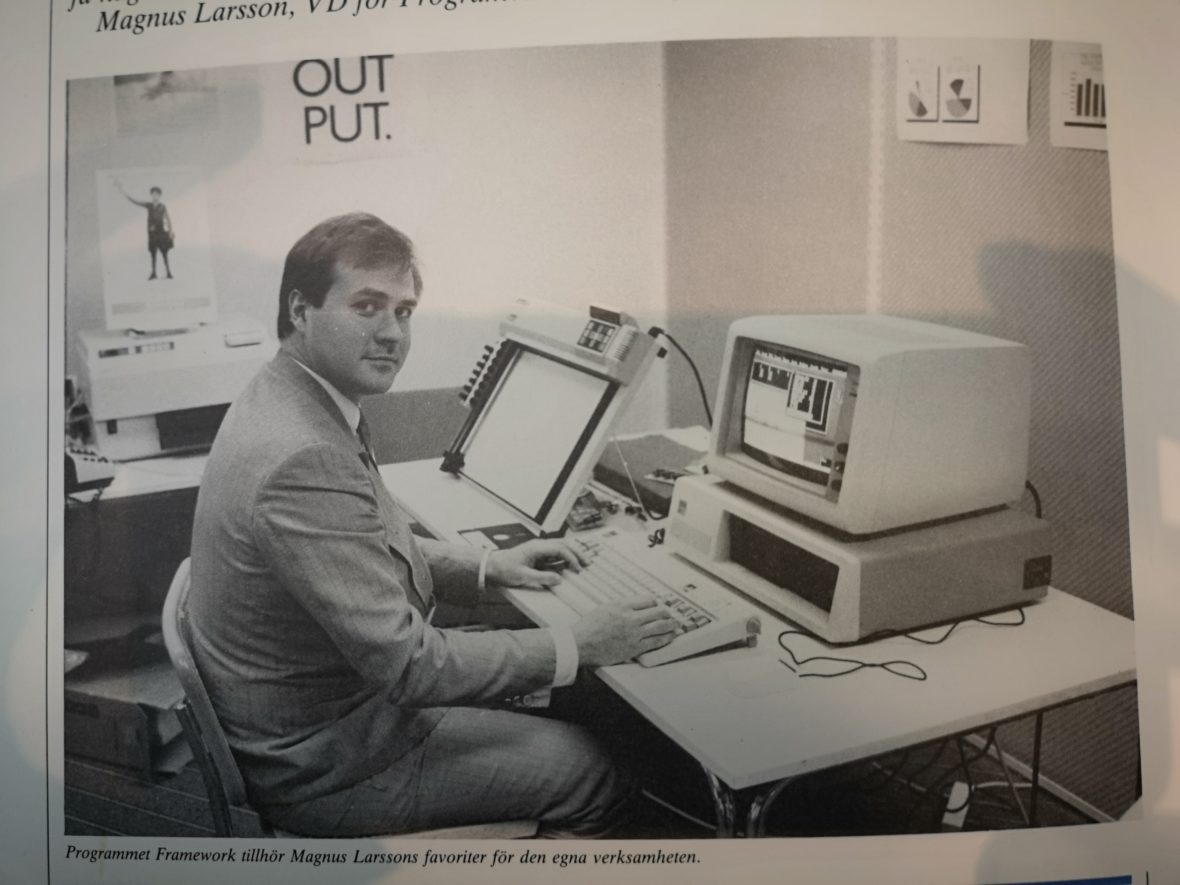
Magnus Larsson remembers the time before Excel
Magnus Larsson has been in the IT industry for more than 40 years. He has made a journey with a company that has gone from zero to a hundred and is proud of what he has achieved. This spring, he left the board of IT&Telecom after many years.
In the 1970s, Magnus Larsson and a friend started their first business. Among other things, they took on the agency for a barcode machine for cash registers. At that time, goods were labeled directly in the stores, unlike today.
- It was never a success. The device weighed far too much," says Magnus Larsson.
The American showed the future
But thanks to the company, Magnus Larsson and his friend received a request. The American Robert Wickham wanted to come to Sweden and lecture on microcomputers.
- We thought it sounded very exciting. Together with the Swedish Society for Information Processing, we managed to attract senior IT managers," says Magnus Larsson.
During the lecture, Wickham showed an overhead image of the Apple II microcomputer, one of the VisiCalc spreadsheet program and a sketch of a modern organization. He then noted that at the middle level of an organization, computers will be used as decision-making tools.
- My friend and I stood and watched. How did the audience react? They shook their heads and thought this was nonsense. These weren't the big computers they were used to," says Magnus Larsson and continues:
- But me and my friend saw the light. That was the start of it all. It was fun, because we were right.
Expander software house
In 1983, Magnus Larsson and three friends started the software company Expander. It was at the same time that the personal computer was launched. And the company's business idea was to sell standard programs. It was tough, but the company grew all the time.
- In the end, we realized that the industry was so international that to survive, we needed to join forces with those who wanted to expand in Europe," says Magnus Larsson.
It's exciting to see what happens to organizations when they go from zero to one hundred
- I have been on a journey with a company that has gone from zero to a hundred. I've managed companies in eight countries with a turnover of SEK 6 billion and 650 employees. When I left in the early 2000s, all regions were making money," says Magnus Larsson.
The way into the IT&Telecom companies' board
In 1986, Magnus Larssons began to get involved in industry issues. Until 1991 he was a member of Leverantörsföreningen LKD, the predecessor of IT&Telekomföretagen. He later returned to the association's board. One event that Magnus Larsson remembers particularly well is the debate on monitors that flared up in the late 1980s. Some researchers claimed that the magnetic fields from them were dangerous.
- The lesson learned was that we made mistakes in the industry. We did what many others did and went on the defensive. Our best experts stepped forward and firmly rejected the claims with the help of research," says Magnus Larsson.
But the debate did not subside. Instead, it intensified. What made the industry think was the then Director General of the State Treasury, Claes Örtendahl.
- He had written in the newspaper that it didn't matter whether it was dangerous or not, but his colleagues were worried sick. The concern itself was something that had to be addressed," says Magnus Larsson.
Don't fight windmills
The industry then chose to introduce copper networks in the monitors that broke off the fields.
- It turned out to be a fantastically clever way. The civil servants' central organization started to notice the screens that had the net built in. This became big and companies started to profit from it," says Magnus Larsson and continues:
- We were thinking wrong from the start and fighting windmills. We have to listen to the customer, even if they are wrong sometimes. And it turned out well in the end and a selling point abroad," says Magnus Larsson.
Commitment to the Confederation of Swedish Enterprise
In recent years, Magnus Larsson has been involved in the Confederation of Swedish Enterprise. He believes that 98% of the challenges facing companies are the same. These include taxes, employer responsibility, complicated regulations, public procurement and, last but not least, skills supply.
- I am happy to have been involved and contributed to something that all companies regardless of industry benefit from. In the end, we all row in the same sea," says Magnus Larsson.